Most of us probably associate fish with swimming but there’s a few species that actually choose walking as their preferred method of getting around.

Unlike most fish who opt for swimming, frogfish are among the species who choose to walk instead. © John Back/ Shutterstock
One group of species that takes a stroll along the ocean floor are frogfish. Our scientist Hannah Teague is here to shed light on these mysterious walking marine residents.
What are frogfish?
Frogfish are members of the order Lophiiformes – the same group that includes the deep-sea anglerfish. There are roughly 50 species of frogfish, which are found throughout tropical and subtropical waters around the world. They live in a wide range of marine habitats, but they’re especially fond of coral reefs and rocky areas, where their excellent camouflage helps them to blend in.

Frogfish are incredibly diverse and vary greatly in size and appearance. © Richard Whitcombe/ Shutterstock
How do frogfish walk?
Frogfish walk using their pectoral and pelvic fins. These fins are muscular and function like limbs, even bending like knee or elbow joints.
“They have two sets of paired fins that act a lot like legs. They have big pectoral fins and slightly smaller pelvic fins, and these work in a couple of different ways,” Hannah explains.
“There are two main walking gaits. One resembles a traditional walk. The other is called crutching, where the larger pectoral fins support most of the body weight. The fish swings these fins forward, then shifts its weight to the smaller pelvic fins as the big pectoral fins move around again.”
“Some frogfish switch between gaits and use them in combination. But some species will also use a walking gait and a swimming gait simultaneously.”

The hairy frogfish can look like a clump of algae on the reef. © Francesco_Ricciardi/ Shutterstock
When frogfish need to move quickly – such as when escaping predators – they switch to a form of jet propulsion. This is when they draw water into their mouths and expel it through small gill openings behind their pectoral fins, launching themselves forward in short, hopping bursts.
Frogfish prefer walking over swimming because they’re ambush predators. Rather than chasing prey, they rely on camouflage and patience, staying still and hidden until their meal comes close enough for them to strike.
How good are frogfish at camouflaging themselves?
Frogfish rely on prey coming to them, so their ability to hide is essential – and they’re exceptionally good at it. Many species can blend almost perfectly into their surroundings by changing not only their colour but sometimes even their texture.
For example, the warty frogfish can imitate the surface of a sponge, while the sargassum frogfish drifts among floating seaweed, even mimicking its movement in the current. The hairy frogfish can look like a clump of algae or marine debris.

Some frogfish, like the yellow frog fish, resemble sea sponges. © Jack FotoVerse/ Shutterstock
“They’re known for their wacky textures, colours and patterns – they’re true masters of disguise,” Hannah says. “One species in particular, the striated or hairy frogfish, can shift between four distinct colours. Depending on the environment, they might turn orange to resemble coral or even go completely black, making them look like a sea urchin.”
This camouflage not only helps them ambush unsuspecting prey but also serves as protection, allowing them to avoid being detected by predators.
How do frogfish hunt?
Frogfish use a unique structure called the illicium to hunt – a modified dorsal spine that works like a fishing rod. At the tip is a fleshy lure called an esca, which looks like the prey of the animal the frogfish is hunting. The esca will hence often look like a worm, shrimp or small fish. The frogfish’s prey is attracted to the esca and unknowingly approaches.
“The illicium is a modified fin. It acts like the rod section of a fishing rod, and it’s tipped with an esca, which is the bait, and this can resemble a worm or crustacean. Frogfish can move the illicium and esca in a special pattern to try and mimic what their prey would be looking for,” explains Hannah.
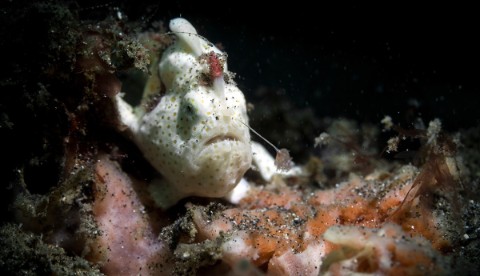
The illicium and esca lure in unsuspecting prey. © AQUADAYEA/ Shutterstock
Once the prey comes close enough, the frogfish strikes with incredible speed – its mouth opening in about six milliseconds.
They mainly eat small fish, crustaceans and sometimes even other frogfish. Thanks to their expandable stomachs, they’ve been known to swallow prey as large as, or even larger than, themselves.
Even though a walking fish might sound like something out of a sci-fi movie, these aquatic creatures are actually wandering along the seafloor right now. So, the next time you think about the ocean, imagine what other strange beings might be lurking beneath the waves.
What on earth?
Just how weird can the natural world be?


Don't miss a thing
Receive email updates about our news, science, exhibitions, events, products, services and fundraising activities. We may occasionally include third-party content from our corporate partners and other museums. We will not share your personal details with these third parties. You must be over the age of 13. Privacy notice.
Follow us on social media