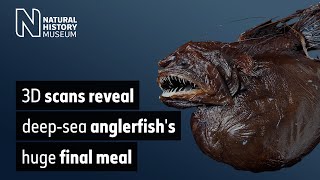
With its luminous dorsal spine, the anglerfish is well adapted for life in the dark depths of the ocean. But when it comes to relationships, some take a rather unconventional route.
Pairings of deep-sea male and female anglerfishes are rather unbalanced.
While the female spends her life hunting, the male is at leisure to simply hitchhike, acting as a passenger for the majority of his adult life.
Watch the video above to see James Maclaine, our Senior Curator of Fish, get up close and personal with one of these unusual pairings.
Love is blind
Males in the suborder Ceratioidei only grow to a fraction of the size of females.
Females have the iconic anglerfish dorsal spine with its luminous flesh lure at the end. However, males don’t have the same head growth or the ability to attract prey.
But what the male lacks in luminosity, he makes up for with an impeccable sense of smell. He uses this to sniff out his future mate in the pitch-black expanse of the deep sea.
However, by the time he’s found her, there’s a chance he’s been beaten to the punch. A female anglerfish was once caught with eight males attached to her!
Undeterred, he uses his small, sharp teeth to latch onto his intended’s side, holding on for the rest of his – and her – life.
In some species the male becomes a permanent attachment to the female, his small body left simply trailing along in the water beside hers. Slowly he fuses to her, becoming an irremovable appendage. This unique mating strategy is known as sexual parasitism – most of the time, the male is just draining resources from the female. However, as the male does occasionally fertilise the female’s eggs, some might describe their attachment as a form of mutualism instead.
In this relationship he’s completely catered for. He no longer needs his eyes, so he loses the ability to use them and relies on his female host for all of his nutrition. Even his bloodstream eventually connects with hers.
But he’s an integral addition to her life, because the male provides sperm. This ensures that the female can produce fertile eggs for the rest of her life, making him vital to species survival.
Deep-sea dwellers only
There are over 300 species of anglerfish living at various ocean depths.
Parasitic behaviour and extreme sexual dimorphism – the noticeable difference in appearance between sexes – is only seen in deep-sea anglerfish species.
In other anglerfishes, the male is closer in size to the female and only encounters her to mate. Unlike their parasitic relatives, these males spend the rest of their lives hunting for themselves and swimming freely in the ocean.
Sorry to surface...
But are you a deep-sea enthusiast? Explore the inky depths in our expert-led, online and on-demand course Deep Sea, available now.

What on Earth?
Find out just how weird the natural world can be.



Don't miss a thing
Receive email updates about our news, science, exhibitions, events, products, services and fundraising activities. We may occasionally include third-party content from our corporate partners and other museums. We will not share your personal details with these third parties. You must be over the age of 13. Privacy notice.
Follow us on social media