Fossils show that ‘Nutcracker Man’ ventured further and wider than previously thought
By Emma Caton
A 2.6-million-year-old fossil is changing our understanding of early human evolution in Africa.
Paranthropus remains found in Ethiopia’s Afar region shows that this group of early hominins were more widespread than previously thought, despite having a highly specialised diet.
The discovery of Paranthropus fossils in northern Ethiopia has changed our understanding of this unusual branch of our early ancestors.
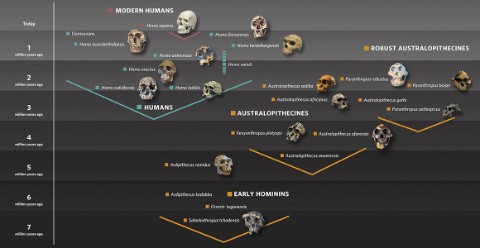
Previously, fossils of this ancient human dating from between 1.4 to 2.8 million years ago and have been discovered in parts of southern and eastern Africa, extending as far north as southern Ethiopia.
But a new study published in the journal Nature describes a new fossil that was found 1,000 kilometres further north than its previous northern-most occurrence. This implies that the genus was far more widespread than first thought.
The new fossil is part of a lower jaw and dated to 2.6 million years old. This makes it not only the most northern but also one of the earliest representations of Paranthropus.
Dr Fred Spoor, one of our human palaeontologists, analysed the fossil with Zeresenay Alemseged from the University of Chicago, whose Ethiopian field project discovered the jaw. Using advanced digital imaging methods they were able to visualise internal parts of the jaw, such as the tooth roots, and compare it with other hominin remains that were found across Africa.
“The fossil shows a mixture of characteristics,” explains Fred. “It is particularly robust and has large teeth similar to later species of Paranthropus. But there are also some features that may be inherited from a less-specialised ancestor.”
“Given this ambiguous combination of characteristics, we decided not to attribute the new fossil to a particular species of Paranthropus at this stage.”
Where was this latest Paranthropus fossil discovered?
The fossil was discovered in the Mille-Logya research area of Ethiopia’s Afar region, an area important in the study of human evolution for its vast array of hominin fossils.
These range from ancient hominins that date as far back as six million years ago to some of the earliest known remains from our own species, Homo sapiens, dating to 160,000 years ago. Other, famous fossils that have been found in this region include the first Australopithecus afarensis skeleton ever discovered, which is widely known by her nickname ‘Lucy’.
But despite this rich history of ancient human discoveries, the absence of Paranthropus fossils has been a long-standing anomaly.
“Surprisingly, Paranthropus remained unknown from the Afar region despite decades of fieldwork uncovering large numbers of fossils that document human evolution,” says Fred.
“Hence, it was thought that Paranthropus never dispersed this far north, perhaps because the environment was not suitable, or it could not compete with species that were present locally.”
This new fossil changes that, and as a result raises some interesting questions about how we think these ancient animals lived.
Paranthropus is often nicknamed ‘Nutcracker Man’ as they had impressive skulls with much larger jaws and molar teeth than our own. They also had flaring cheek bones and ridges on the braincase indicating strong chewing muscles.
All of these features suggest that they lived on a specialised diet of tough plant foods. This indicates that Paranthropus was limited in the places it could live as it would have been determined by available food sources.
But this latest discovery seems to challenge that. It appears that Paranthropus had greater dietary flexibility than first interpreted, could adapt to a wide range of environmental conditions and was as widely distributed in Africa as other groups of extinct human relatives, including Australopithecus and early Homo species.
But Paranthropus was not the only hominin species in the Afar region that had notably large molar teeth.
This feature was shared with Australopithecus garhi, which lived at broadly the same time. A co-occurrence of two ‘heavy chewers’ is a first in human evolutionary history.
Dental size alone may not necessarily suggest that the two would have competed over food resources and so more evidence is needed to understand better how jaws, chewing and diet are related.
“The discovery of Paranthropus in the Afar highlights how little is known about human evolution in eastern Africa during the crucial period between 2.5 and 3 million years ago, when the oldest fossils of this genus and the Homo lineage are found,” says Fred.
Receive email updates about our news, science, exhibitions, events, products, services and fundraising activities. We may occasionally include third-party content from our corporate partners and other museums. We will not share your personal details with these third parties. You must be over the age of 13. Privacy notice.
Follow us on social media
Accept cookies?
We use cookies to give you the best online experience. We use them to improve our website and content, and to tailor our digital advertising on third-party platforms. You can change your preferences at any time.


Don't miss a thing
Receive email updates about our news, science, exhibitions, events, products, services and fundraising activities. We may occasionally include third-party content from our corporate partners and other museums. We will not share your personal details with these third parties. You must be over the age of 13. Privacy notice.
Follow us on social media