Earliest fire-making dating back 400,000 years unearthed in Suffolk, England
By Josh Davis
The controlled use of fire is one of the reasons our species was able to survive and spread around the world.
But the newly unearthed evidence of the earliest fire-making shows that we were not the first species to master the flame.
“It’s an astounding discovery. This is a game-changer in the field.”
Together with his colleagues, Simon Parfitt has been digging at a site near Barnham, Suffolk, for almost two decades. They have unearthed the remains of lions, beavers, and monkeys. But it is a couple of tiny two-centimetre fragments of rock that are set to turn the history of human evolution upside down.
Known as pyrite, the fragments were found with hearths of 400,000-year-old campfires. Rather incredibly, they show that these fires were not accidental but purposefully lit and maintained. This was at a time when the ice sheets had not long retreated from across the UK, and as our own species was evolving in Africa.
It means that these ancient humans were able to stay warm and push into ever colder regions. They were able to cook food and make tools even after the sunset. And it may have provided a focus for socialising and teaching.
Simon is a senior researcher in our human evolution research group and at University College London and was there the moment the pyrite fragments were found.
“As soon as we saw the pyrite, we realised we had found something remarkable,” recalls Simon about the moment it was unearthed. “Because pyrite doesn’t occur naturally in that landscape, its presence shows they had the ability to make fire at will. It would have been an essential part of a fire-making toolkit.”
The site at Barnham was originally a clay pit that, towards the end of the nineteenth century, supplied the raw material to make the bricks for local buildings. Even at this point, those digging the clay were unearthing the remains of ancient animals such as elephants, alongside evidence of humans in the form of flint tools.
These animals were likely drawn to this particular spot as the site was then a spring-fed lake surrounded by grassland and open woodland.
By the start of the twentieth century, the clay pit was abandoned. But the tantalising combination of animal bones and human tools meant that researchers returned, first in the late 1980s, and then more substantially in 2013.
For the last decade, excavations have once more been taking place at Barnham, revealing an extraordinary ancient ecosystem.
Alongside the bones of large animals such as bison, elephants and deer, researchers have uncovered the fossils of frogs, fish and even macaque monkeys. They have built an incredible picture of a thriving wetland ecosystem at the edge of a lake close to half a million years ago.
But they also found the distinct evidence of humans in two defined ways.
“We have two different stone tool industries, which is another really interesting aspect of the site,” Simon explains. “In the lower part of the sequence, they were making very simple flake-like tools, which are just chipping off blocks of flint. This group were making cutting tools and perhaps turning the flakes into scrapers.”
“Higher up in the sequence we then find handaxes which were made with a much more complex process that involves high levels of skill, but also the ability to look at an amorphous piece of flint and say, ‘okay, I want to make a symetrical hand-sized cutting tool out of that.’ There is more intentionality to it.”
The current view is that these two different styles of tools were made by different species of people. But that is not the most important find that the archaeologists made at Barnham. While looking at the scatters of flint left behind by this second group of people, they noticed something intriguing.
The piles of flint were non-randomly distributed. They formed patches throughout the site, and the flints were reddened and cracked, a sign that they were intensely heated. Analysis of the sediment further showed that there was repeated burning. What the team had uncovered was a series of ancient campfires, around which these people were making their tools.
But the real discovery came when two little pieces of pyrite rock were uncovered in the same areas as the campfires. Up until this point, it was effectively impossible to know if the fires had started naturally from, for example, lightning strikes, or purposely created by people.
The presence of pyrite was an unmistakable sign. Striking flint against pyrite nodules creates sparks, and which can be used to start fire. This pushes back the earliest known controlled use of fire by humans by at least 360,000 years.
“The fact that there are the pyrites shows not just that they could maintain the fire, but they were making fire,” explains Dr Silvia Bello, one of our experts on ancient human behaviour.
The ability for people to make and control fire is a huge moment in human evolution. Fire was key to keeping predators like the lions and wolves at bay and staying warm on cold nights, but it would also have radically altered aspects of social behaviour too.
“Fire is a source of warmth, and on cold, dark nights it can extend the day,” says Silvia. “Surely at times when people couldn’t hunt, the fire was a good space to gather, interact with each other and potentially learn and teach.”
“There is always this aspect, that is a bit less visible in archaeology, which is the transmission of knowledge. The knowledge from adults to the kids, or the opportunity of learning from each other how to make and use tools. I imagine that fires were good learning areas.”
Although impossible to know for certain, this could explain the piles of waste flint flakes found surrounding the campfires, as if people had been sat around them making tools in the flickering light.
But the fire would have changed people in other ways too. Cooking food on demand, for example, makes it easier to digest and break down plants and meat and so would have allowed humans to exploit a much wider range of resources. This also impacts the growth and evolution of our bodies, such as the size of teeth and even the brain.
It would also have sent smoke up, above the horizon. This would mean that people could potentially have communicated over much greater distances. At the very least, it might have allowed people to better understand how many other people were living in the region and where.
But which people would this have been? That is the question on everyone’s lips, and is perhaps harder to answer than might be expected.
Who was making the fires at Barnham?
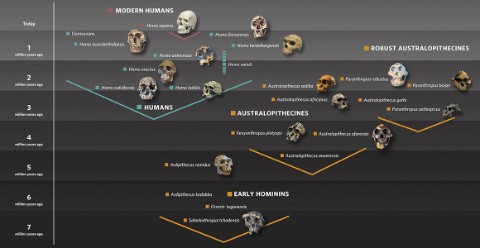
By 400,000 years ago, our own species, Homo sapiens was evolvingacross what is now Africa, so it couldn’t have been us.
There are, however, a few different candidates. It is thought that the earlier Clactonian tools may have been made by Homo heidelbergensis. The people who came later and started the fires though were likely to be yet another species of human.
“So the layer at Barnham with the handaxes and the fire is around the same age as another site at Swanscombe, where we’ve got the Swanscombe skull,” explains Professor Chris Stringer, one of our experts in the evolution of humans.
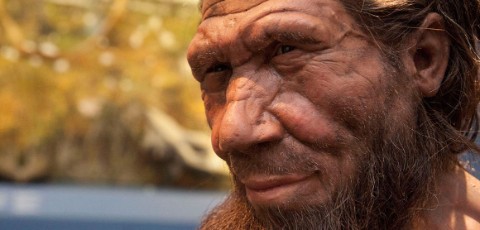
“That skull is pretty certainly an early Neanderthal, so by inference the people at Barnham making these fires would have been early Neanderthals too. But we don’t know for certain, because we haven’t got any human fossils at Barnham itself yet.”
Regardless of who was making these fires, the very fact that the ability to create fire occurred so early in the human lineage is astounding, and raises some intriguing thoughts.
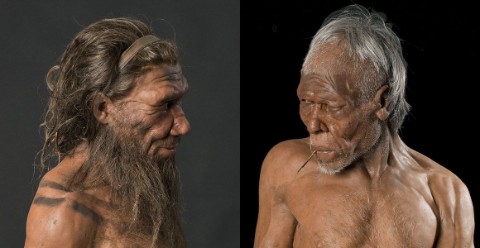
When our own species first appeared in Europe, it would mean they were entering a world already filled with a range of other human species. These other humans were crafting tools, weapons and fire.
As our ancestors travelled across the landscape and explored new lands, they would have seen the whisps of smoke on the horizon and encountered the still-warm campfires from other human species.
What we made of these signs is impossible to know, but far from being pioneers, we were perhaps stepping in the footsteps of others.
Explore human evolution
Our scientists and the collections we care for are helping to answer where, when and how humans evolved.
Receive email updates about our news, science, exhibitions, events, products, services and fundraising activities. We may occasionally include third-party content from our corporate partners and other museums. We will not share your personal details with these third parties. You must be over the age of 13. Privacy notice.
We use cookies to give you the best online experience. We use them to improve our website and content, and to tailor our digital advertising on third-party platforms. You can change your preferences at any time.


Don't miss a thing
Receive email updates about our news, science, exhibitions, events, products, services and fundraising activities. We may occasionally include third-party content from our corporate partners and other museums. We will not share your personal details with these third parties. You must be over the age of 13. Privacy notice.
Follow us on social media