CollectionsBritish fish records: How the UK’s biggest fishes are found
From titanic tuna to colossal cod, every angler dreams of a record-breaking catch.
For more than five decades, our scientists have been helping to verify these big fish and are using these sizable specimens to better understand life in the UK’s waters.
In the depths of the Natural History Museum lurks an exclusive club of record breakers – the British record fish.
From tiny gobies weighing about the same as a pencil to rays tipping the scales at over 46 kilogrammes, they are the largest fishes of their kind ever caught in the UK. To have a catch join the ranks of the record fish is one of the greatest honours an angler can have, establishing a landmark that can last for decades.
But before they can become a record fish, these animals must be carefully checked. Our curators have been verifying the UK fish records for more than 50 years, ensuring only the true giants of a species make their way onto the British record fish list.
Though the record fish may be impressive in their own right, they also play an important role in understanding life in the UK’s rivers, lakes and seas by showing how marine populations are changing.
What is the British Record Fish Committee?
The British Record (Rod Caught) Fish Committee (BRFC) is the team of scientists and anglers who look after and verify the British angling records for the Angling Trust.
Any angler who catches what they believe to be a record-breaking fish in the UK and Channel Islands waters can apply to the BRFC to have it checked. Whenever a potential new record is submitted, one of the BRFC’s scientific advisors gets called in to investigate.
Since 1975, when the head of the then Fish Section Alwyne Wheeler started advising the BRFC on marine fishes, it’s been one of the more unusual jobs for our scientists. Alwyne’s mantle was passed onto his successor, Oliver Crimmen, who in 2023 passed it on to James Maclaine, our current Senior Curator of Fishes.
“Our job as advisors is to certify the identification, which depending on the species can either be very easy or not easy at all,” James says. “We discuss the evidence at BRFC meetings twice a year, where the measurements of the fishes are compared with existing records.”
“The number of submissions really varies from year to year. I find that they come along a lot like buses – some years there are very few, but others there are so many!”
Some species of fish can have multiple records depending on how they’re caught. For example, the largest shore-caught haddock weighs just over three kilograms, while the biggest boat-caught haddock comes in at 6.2 kilograms.
A British record might also be a world record for fish, but the BRFC doesn’t make judgements on this. If an angler believes they’ve caught one of the biggest fishes in the world, they need to apply to the US-based International Game Fish Association.
How are the biggest fish ever caught in the UK confirmed?
James’s job is to ensure the integrity of the record fish list by confirming which species has been caught. This is done using videos, photos, witness statements and sometimes the fish itself.
“In many cases, anglers catch a fish then film or photograph themselves measuring it to show how big it is before releasing it back into the water,” explains James. “This is normally enough to identify the species.”
When species are tricky to confidently identify, however, an angler might choose to keep the fish. Many of these end up being sent to James to be examined, often through the post.
“Generally, as long as something’s posted immediately after being caught or taken out of a freezer, and well-wrapped up, it can get here in pretty good condition,” James says. “They’re normally well-preserved enough to get a tissue sample from, which can give us more details about the animal’s life.”
“The only thing not to do is to post it at the end of the week – otherwise, it might not arrive until after the weekend, meaning it’s pretty pungent when it gets here.”
Once the specimen has arrived, it’s unwrapped and studied by James. While some fish might have external characteristics that make their identification obvious, others could need dissecting, X-raying or DNA analysis.
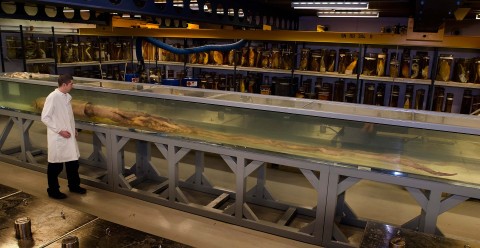
The fishes are then injected with a substance known as formalin to preserve their bodies, before being placed in glass jars of concentrated alcohol to preserve them forever. Occasionally, the fish are so big they need to be stored in a tank instead.
Once labelled and sealed in a jar, the fish will become part of our collection of fishes and kept to help answer questions about the natural world.
What can British record fish tell us?
The British record fish are useful in a number of ways, not least because they can show how big different species can grow. Their real importance, however, is through forming part of our wider fish collection.
“It’s always important to expand the collection, and the record fish will be preserved in perpetuity to help answer any kinds of scientific questions that people might come up with,” adds James. “The more variety we have in the collection, the better we’ll be able to answer these questions.”
Fish that are rarely caught in the UK are particularly important for our collections. They can help scientists to track whether new species are moving into the UK’s waters.
“A couple of years ago Oliver Crimmen confirmed a record of a comber, Serranus cabrilla, in the UK,” James recalls. “This species tends to prefer warmer water but they are becoming more common along the south coast of the UK.”
“It’s possible this could be a larger population shift as part of climate change. Keeping fishes like these in the collection provides useful data that could help identify if an occurrence is part of a larger pattern.”
James’s work with the BRFC also provides an opportunity to speak to anglers and their families, who have witnessed first-hand the changes to fish populations around the UK. Some of these relationships have lasted for decades, with the great-grandchildren of record-breaking anglers coming to visit their ancestors’ catch in our collections.
“One trend I’ve heard recently from speaking to anglers such as Pete Hegg is that bluefin tuna are making a real comeback after their populations crashed in the twentieth century,” James recalls. “As they eat species like garfish, it’s changing the ecosystems we’ve seen over the past 50 years or more.”
“We wouldn’t get insights like these without a good relationship with the angling community.”



Don't miss a thing
Receive email updates about our news, science, exhibitions, events, products, services and fundraising activities. We may occasionally include third-party content from our corporate partners and other museums. We will not share your personal details with these third parties. You must be over the age of 13. Privacy notice.
Follow us on social media