With their big eyes, curious nature and adorably fluffy pups, it’s easy to love seals.

Seals maintain balance in marine ecosystems. They’re predators but also prey for larger animals. © Alex Vog/ Shutterstock
Fortunately for us, these charismatic creatures are quite common in the UK, with our shores home to two species.
Discover what makes a seal a seal, their impressive adaptations and the threats these important animals face.
What is a seal?
Seals are semi-aquatic marine mammals. They’re also known as pinnipeds, which means ‘fin-footed’, referring to the large flippers they have for arms and legs. Combined with their streamlined, torpedo-shaped bodies, this makes seals incredibly fast and agile in the water.
When they need to rest, digest their food or give birth, seals haul themselves out onto beaches, rocks or ice. In some places, thousands of seals gather together in colossal colonies, particularly during the breeding season.
While many seals mate on land, some species, such as walruses, mate in the water. Seals reproduce once a year and usually have one pup at a time. When pups are born, some can swim within a few hours, whereas others spend several weeks on the shore before they enter the ocean for the first time.

The world’s fastest seals are the California sea lionsopens in a new window. They can zip along underwater at 40 kilometres per hour in short bursts. © Gail Salter/ Shutterstock
How many species of seal are there?
There are 35 species of seal living around the world.
The largest species is the southern elephant seal. It’s found in Antarctic and sub-Antarctic waters. Males can be up to six metres long and can weigh up to 3,700 kilogrammes.
The Caspian seal and the closely related Baikal seal are among the smallest species. Both measure in at up to about 1.4 metres in length. The Baikal seal is also the only exclusively freshwater seal species.
Two species of seals live in the UK – the grey seal and the harbour seal – although we’re also occasionally visited by a variety of other seal species, including walruses.
Are seals and sea lions the same thing?
All living seal species belong to one of three groups – eared seals, earless seals or walruses.

Eared seals have ears with small external flaps (left), whereas earless seals have ears that have no visible external structures (right). Left image © lfstewart/ Shutterstock. Right image © TashaBubo/ Shutterstock.
Despite their name, earless seals do have ears – they’re the small holes located on the sides of their head, just behind their eyes. This group is also known as the Phocidae family, or ‘true’ seals, and contains 18 species, including elephant seals, harp seals and hooded seals.
Eared seals – members of the Otariidae family, including sea lions and fur seals – are named for their visible ears, which although rather small, do have external flaps.
On land, eared seals ‘gallop’ around, supporting their body on all four flippers. Earless seals, on the other hand, bounce along on their bellies. They also differ in how they propel themselves in the water, with eared seals mostly using their arms, whereas earless seals typically use their hindlimbs.
Walruses are a separate group, but they’re more closely related to eared seals. There’s only one living species of walrus.
What does a seal look like?
While seals all have similar body plans, there’s still plenty of variety in appearance between species. Scroll through some examples below.

Walrus, Odobenus rosmarus. © jiristastny.cz/ Shutterstock

Steller sea lion, Eumetopias jubatus. © Jukka Jantunen/ Shutterstock

Leopard seal, Hydrurga leptonyx. © Tarpan/ Shutterstock

Southern elephant seal, Mirounga leonina. © David Osborn/ Shutterstock

Antarctic fur seal, Arctocephalus gazella. © stylefoto24/ Shutterstock

Bearded seal, Erignathus barbatus. © Susan Rogers/ Shutterstock

Hawaiian monk seal, Neomonachus schauinslandi. © Trudy Simmons/ Shutterstock

Baikal seal, Pusa sibirica. © withGod/ Shutterstock

Grey seal, Halichoerus grypus. © Subphoto.com/ Shutterstock

Harbour seal, Phoca vitulina. © Giedriius/ Shutterstock
Are seals related to dogs?
People sometimes nickname seals ‘puppies of the sea’, this is either likely because of their curious nature or the bark-like calls of some species.
While some dogs look oddly seal-like, this is quirk of dog breeding rather than dogs actually having evolved from seals or vice versa.

Harbour seals have slightly concave faces, which gives them a dog-like appearance. © TasfotoNL/ Shutterstock
Dogs and seals belong to a group of animals called Carnivora. However, seals are more closely related to mustelids – a group of animals that includes raccoons, weasels and red pandas – than they are to dogs.
Seals may have evolved from four-legged, otter-like animals that adapted over time for life in the ocean – a bit like how whales evolved from land-based animals.

Seals have small tails between their large, paddle-like rear flippers. © Dutchmen Photography/ Shutterstock
What do seals eat?
Seals are carnivores that mostly hunt for fish, invertebrates, such as crustaceans and cephalopods, and seabirds, such as penguins.
They catch and tear their prey with their sharp teeth. Some seal species even have special tooth adaptations. For example, crabeater seals and leopard seals have extra lobed teeth for sieving krill out of the water – a bit like how baleen whales feed.
Walruses’ iconic tusks are actually metre-long canine teeth that they use for fighting and dominance in their social groups. They also use them to make and maintain holes in the ice and will sometimes drag them along the seabed to dislodge prey.

A fur seal skull from the mammal collection we care for.
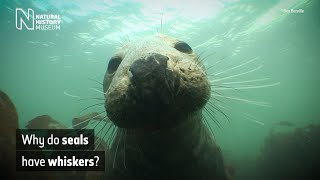
Seals have large eyes and sensitive whiskers, which can detect movement underwater, helping them to hunt in deep and murky waters.
Why do seals have fur?
Most seals live in the planet’s cooler regions, so their fur helps them to stay warm and dry. Some species have a double layer of fur – a fine underfur traps air, helping to insulate them, and an outer layer of coarse guard hairs keeps out moisture.
Seals are usually shades of brown or grey. Some species are speckled patterned, while the ribbon seal is unusual in that it has bold patches. Each year, seals come ashore for a few weeks to moult their coat and grow a new one.
Seals also have a layer of fat known as blubber. The blood vessels in blubber contract when the seal is cold, stopping it from losing body heat. Then when the seal needs to lose excess body heat, these blood vessels dilate.

Blubber and dense fur help seals to stay warm. © Jess Latimer/ Shutterstock
What threats do seals face?
Six seal species are currently considered endangered and a further four are classed as vulnerable to extinction. Since the 1970s, both the Japanese sea lion and Caribbean monk seal have gone extinct.
People have hunted seals for a very long time, mostly for their blubber, fur and meat. Commercial sealing peaked in the 1700s and 1800s, causing significant population declines. Seals are generally better protected now, including in the UK, where it’s illegal to harm them, but some countries do still hunt seals.
Climate change could impact seals in a variety of ways too. For example, melting sea ice is a significant threat to species that live and raise their young in the Arctic. Extreme weather events can separate young pups from their mothers or wash them off the shore before they’re able to swim. We may also see the distribution and quantity of important prey species change as a result of warming and acidifying oceans.
Seals are also at risk from collisions with boats and their propellors, which can cause them horrific injuries or even be deadly. So can entanglement in fishing gear and barriers such as shark nets or ingesting plastic and other waste.

Seals and other marine mammals are getting caught in fishing gear. This can wrap tightly around them, cutting into their bodies and restricting their movement and ability to feed. If seals get trapped underwater, they can drown. © Kev Gregory/ Shutterstock
There’s also the ever-present threat of persistent organic pollutants in the ocean. These build up in seals’ bodies when they eat contaminated food, effecting their immune systems, growth and reproduction. They can pass these toxic chemicals up the food chain to their predators too.
How to keep seals safe
Seals are predators as well as prey for larger animals, including killer whales and polar bears. If seal numbers decline, it could have ripple effects up and down the food chain, destabilising nutrient cycling and the wider ecosystem.
We need to keep seals safe to help our planet thrive. If you go seal watching, don’t forget to:
- Keep your distance. Use binoculars or a camera to watch seals from at least 100 metres away. If you unexpectedly encounter a seal, change your route or make as wide a detour as possible. When threatened, seals can be aggressive in self-defence and mothers may even abandon newborn pups.
- Be as quiet as possible. Loud noises can scare seals and make them flee into the ocean. If a colony of seals stampedes, they may injure each other.
- Keep dogs under control. Curious pets can cause serious stress and injury to seals. Dogs should be kept on a lead or left at home.
You can take action at home to make the ocean a safer place for seals too, such as by reducing your plastic waste and disposing of it responsibly, or by eating ethically sourced seafood.
Find more actions that are good for you and good the planet.
Abandoned pups and seals in distress
If you’ve seen a sick or injured seal or a pup that’s been alone for more than 24 hours, don’t try to rescue it yourself.
Call the British Divers Marine Life Rescue hotlineopens in a new window for advice on 01825 765546.
If you spot a dead seal, whale, dolphin, marine turtle or large shark in England or Wales, report it to the strandings team by emailing [email protected] or calling 0800 6520 333.
Discover oceans
Find out more about why we’re working to protect the oceans.


Don't miss a thing
Receive email updates about our news, science, exhibitions, events, products, services and fundraising activities. We may occasionally include third-party content from our corporate partners and other museums. We will not share your personal details with these third parties. You must be over the age of 13. Privacy notice.
Follow us on social media