Meet the main groups of meteorite. Discover how they differ in their amount of iron-nickel metal and what they can tell us about the early solar system.

A slice of Canyon Diablo iron meteorite showing Widmanstätten texture.
What are the different types of meteorites?
There are three main types of meteorites:
- iron meteorites are almost completely made of metal
- stony-iron meteorites have nearly equal amounts of metal and silicate crystals
- stony meteorites mostly have silicate minerals
Each of these groups can be split into many more classes and types of meteorite depending on the minerals, structure and chemistry.
Iron meteorites
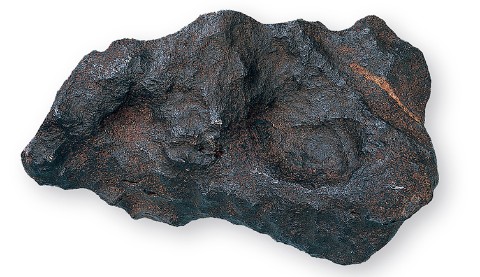
A piece of the Henbury iron meteorite, which was found in Australia. It’s 28cm across and has a dark fusion crust.
Most iron meteorites are thought to be the cores of asteroids that melted early in their history. They consist mainly of iron-nickel metal with small amounts of sulphide and carbide minerals.
During the decay of radioactive elements in the early history of the solar system, many asteroids melted. The dense iron they contained sank to the centre, forming a metallic core.
Meteorites from melted asteroids are also known as differentiated meteorites, as they’ve experienced major chemical or physical changes, solidifying from a molten state.
Sometimes they have an iron core and concentric layers, surrounded by a silicate mantle and crust.
This type of structure is very similar to the terrestrial planets in our solar system – Mercury, Venus, Mars and Earth – which also have metallic cores. Iron meteorites can tell us a lot about how the metallic cores of planets formed.

An iron meteorite cut and etched with acid to reveal its crystal structure.
Iron meteorites are mainly made of an iron-nickel alloy with a distinctive crystalline structure known as a Widmanstätten texture. It’s caused by the iron and nickel in the meteorite cooling at a rate of about 1°C every million years.
There can be wide variation in the texture and mix of minerals present within iron meteorites. This means there are many groups and subtypes.
Stony-iron meteorites
Stony-iron meteorites consist of almost equal parts iron-nickel metal and silicate minerals, including precious and semi-precious gemstones. They’re considered some of the most beautiful meteorites.
There are two different types of stony-iron meteorites – pallasites and mesosiderites.
Pallasites

A cut and polished slab of the pallasite meteorite Imilac. This specimen is thought to have once been part of a much larger meteor that exploded over the Atacama Desert in northern Chile, possibly in the fourteenth century.
Pallasites contain big, beautiful olive-green crystals – a form of magnesium-iron silicate called olivine – embedded entirely in metal. Sometimes the olivine does not occur as a single crystal but as a cluster. Elsewhere it can create a pattern of veins through solid metal.
The scientific jury is still out on exactly how pallasite meteorites formed. Some scientists believe they formed in melted asteroids in a similar way to iron meteorites, where dense iron metal sinks toward the centre to form an iron core. Pallasites are thought to be samples of the boundaries between a metal core and the silicate, olivine-rich mantle around it. If this is the case, they could tell us a lot about the formation of Earth and other terrestrial planets.
However, other scientists think that there are very few olivine-rich meteorites in the asteroid belt, and too many pallasite meteorites for them all to have come from a core-mantle boundary. These types of formations may also be formed by impact melting.
Look out for the pallasite meteorite Imilac on display in our Hintze Hall.
Mesosiderites

The Estherville mesosiderite formed after a collision between two asteroids. It fell in 1879 in Iowa, in the United States.
Mesosiderite meteorites are breccias – a variety of rock made up of broken fragments of minerals or rock cemented together by a finer material. The fragments are roughly centimetre-sized and contain a mix of igneous silicate and metal clasts – rocks made of pieces of older rocks.
Mesosiderites form when debris from a collision between two asteroids is mixed together. In the crash, molten metal mixes together with solid fragments of silicate rocks. Mesosiderites can therefore record the history of both meteorites and reveal a snapshot of the conditions required for asteroids to melt and form iron cores.
Stony meteorites
The majority of meteorite finds are stony meteorites, consisting mostly of silicate minerals.
There are two main types of stony meteorite – chondrites, which are some of the oldest materials in the solar system, and achondrites, which include meteorites from asteroids, Mars and the Moon.
Both chondrites and achondrites have many subgroups based on their compositions, structures and the minerals they contain.
Chondrites

A cut slab of the Parnallee meteorite, a chrondite that fell in Tamil Nadu, India, in 1857.
At over 4.5 billion years old, chondrites are some of the most primitive and pristine rocks in the solar system and have never been melted.
Chondrites have a distinctive appearance, made from droplets of silicate minerals mixed with small grains of sulphides and iron-nickel metal. They’re named for their millimetre-sized granules called chondrules, which comes from the Greek ‘chondres’, meaning sand grains.
There are many varieties of chondrite, with differences in mineralogy relating to the type of asteroid the meteorite came from.
Chondrites are the material from which the solar system formed. They’ve been little changed compared with rocks from larger planets, which have been subjected to geological activity. Chondrites can tell us a lot about how the solar system formed.
The Murchison meteorite that fell in Australia in 1969 is a chondrite. It also smells a bit like Brussels sprouts. Dr Helena Bates explains why. Video with audio description (1 minute 31 seconds).
The most basic types of chondrites are called carbonaceous chondrites. These are rich in water, sulphur and organic material. They’re thought to have brought volatile material to Earth when it was newly formed, helping to establish the atmosphere and other conditions required to sustain life.
Achondrites

The Stannern achondrite fell in 1808 in the Czech Republic.
Achondrites include meteorites from asteroids, Mars and the Moon. They’re igneous, meaning at some point they were melted into magma. When magma cools and crystallises, it creates a concentric layered structure. This process is known as igneous differentiation.
The rocky planets Mercury, Venus, Earth and Mars were formed in this way, giving them planetary crusts, mantles and cores. Achondrites can tell us a lot about the internal structure and formation of the planets, including our own.
Want to find out even more about meteorites? Check out our handy meteorite FAQ.

Ready to explore the universe?
Expand your knowledge with our on-demand course Rocks in Space. Explore the wonders of asteroids, comets and more with our expert-led, online course.

Explore space
Discover more about the natural world beyond Earth’s stratosphere.


Don't miss a thing
Receive email updates about our news, science, exhibitions, events, products, services and fundraising activities. We may occasionally include third-party content from our corporate partners and other museums. We will not share your personal details with these third parties. You must be over the age of 13. Privacy notice.
Follow us on social media