Human evolutionDenisovans: The enigmatic ancient humans who finally have a face
Denisovans were a type of ancient human that for a long time were known only from their DNA and teeth. But recent fossil findings and analysis is now revealing what these people looked like and that they were likely a species called Homo longi.
Along with Neanderthals, Denisovans are our closest extinct human relatives. In fact, some recent studies indicate the Denisovans are the most closely related to our own lineage.
Who discovered the Denisovans?
In 2008, Russian archaeologists digging in the Denisova Cave in the Altai Mountains of Siberia, Russia, uncovered the first fossil remains to be recognised as Denisovan. These fossils consisted of a tiny hand bone and some teeth thought to have belonged to a juvenile human.
Humans occupied the cave multiple times over the past 200,000 years. Evidence suggests that both Neanderthals and our own species, Homo sapiens, also lived in it at various points in time.
But it was in 2010, when a group of international scientists published DNA results from the hand bone, that the story of human evolution shifted radically. The team found that the fossils came from an entirely unknown species of ancient human.
There weren’t enough fossils to be able to officially give the species a scientific name. Instead, they were referred to as a new kind of human called a Denisovan after Denisova Cave where the remains were found.
What species were the Denisovans?
Over the next decade scientists started to review other human fossils that had been unearthed across Asia over the past century. This revealed that many other fossil remains already in collections, including jawbones, ribs and skulls, also likely belonged to Denisovans or their early relatives.
This included a cranium from Harbin, China. In 2021, this was identified by a team of Chinese scientists, as well as our own expert Professor Chris Stringer, as belonging to a new species of human. They named it Homo longi, after the Long Jiang, or Dragon River, in the Heilongjiang province of China.
A new study published in 2025 was able to extract fragments of DNA from hardened plaque on the teeth of the Harbin skull, dubbed ‘Dragon Man’. Comparison with the DNA from the known Denisovan fossils unearthed in Siberia confirmed that they were the same species.
So, the scientific name for the Denisovans is Homo longi.
What did Denisovans look like?
The realisation that Dragon Man is a Denisovan means that a range of other ancient human fossils unearthed over the last century across eastern Asia are probably also closely related to Denisovans. These include some near-complete skulls.
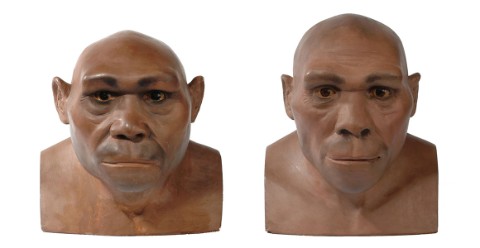
Suddenly this gives researchers a much better idea of what these ancient people looked like, at least in parts of their range.
Those Denisovans that lived in the colder, higher altitude environments of southern Siberia, the Tibetan Plateau and northeast China were supremely well-adapted to these extreme conditions. They were stout and thick bodied, even more so than their Neanderthal cousins.
Among their most distinctive features were large molar teeth, robust jaws and, in many cases, a complete lack of wisdom teeth.
It’s difficult to say more about how Denisovans looked, such as estimating their weight, because no entire skeleton has yet been found. This also means we don’t currently know how tall Denisovans were.
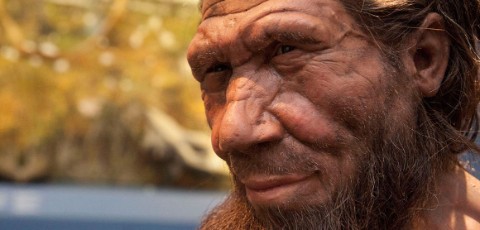
Differing adaptations may have allowed Neanderthals and Denisovans to coexist across parts of Asia for long periods of time. While Neanderthals were probably more suited to hunting wild animals in the woodlands and plains of Europe and western Asia, the Denisovans may have been exploiting the colder, harsher climates of the east Asian mountains and steppes.
But this is only part of the picture. As more Denisovan DNA is sequenced it’s becoming clearer that there were genetically distinct populations of Denisovans living across Asia and down into the islands of southeast Asia.
“It gets quite complicated,” explains Chris, “because there seem to have been at least three kinds of Denisovans around.”
“The different patterns found in people’s genomes today suggest divergences of up to 400,000 years between these Denisovan groups. If that’s correct, the Denisovans were quite diverse. More so than Neanderthals.”
This huge genetic diversity is probably related to the massive range of environments Denisovans lived in, from the high-altitude mountains of the Tibetan Plateau down to the low-lying tropical islands of Indonesia.
Whether or not their genetic diversity was also reflected in how they looked is unknown. So far, the most complete fossil remains for Denisovans have been found in the more northerly limits of the species’ distribution. Until more complete fossils are discovered in other parts of their range, we’ll have to wait and see.
What Denisovan skulls have we found?
After researchers suspected that some of the other ancient human fossils found across eastern Asia might have belonged to Denisovans, many have been reassessed.
This has led to the realisation not only that the Dragon Man skull was likely Denisovan, but also that other skulls might be related. For example, a study published in 2025 found that two of the Yunxian crania, discovered in Hubei, China, likely belonged to the ancestors of the Denisovans.
“These fossils have usually been called Homo erectus by researchers,” explains Chris. “But for a long time I haven’t thought that they were Homo erectus as I could see that the shape was not typical, although I’d never had a closer look at them.”
Experts have also suggested that the Dali skull, found in 1978 in Dali County, China, might also be related to the Denisovans.
Where did Denisovans live?
Fossil remains of Denisovans have been found in Russia, China, Taiwan and possibly Laos. Genetic evidence, however, shows that they were living across much of northern and eastern Asia, and down into the islands of Southeast Asia.
One study has found that, hypothetically at least, Denisovans could have lived as far west as eastern Europe. But there’s no physical evidence of this yet.
Did our ancestors mate with Denisovans?
Yes, our ancestors mated with the Denisovans. We know this because – in the same way that all people alive today with ancestry from outside of Africa have bits of Neanderthal DNA in their genome – many populations in Asia and the Americas today have bits of Denisovan DNA too.
“It’s especially common in people from Island Southeast Asia, in places like the Philippines, Papua New Guinea and Australia,” explains Chris. “They have the largest amounts of Denisovan DNA, sometimes 4 or 5% of their genome. And of course, that's on top of the around 2% of Neanderthal DNA that everyone outside of Africa has.”
Because the Denisovan DNA in our genomes is in larger chunks than that from the Neanderthals it means that the interbreeding between our species must have been more recent. In some regions it may have taken place as late as 30,000 years ago. This means that as our ancestors were migrating around the world and island hopping across to Australia, they were mingling with Denisovans still living in the area.
The benefits of Denisovan DNA
While most of the Denisovan DNA in our genomes is unlikely to be having an impact, some of it might be helping some populations to survive.
Sherpas and other Tibetans live at extreme altitudes and yet can breathe easily. The specific gene that helps them do this is thought to have been inherited through an interbreeding event with Denisovans around 40,000 years ago. The adaptation allows them to use smaller amounts of oxygen more efficiently.
Scientists also think that the immune systems of people from Papua New Guinea have been partly supplemented by Denisovan DNA, and that this might have allowed our species to survive in a new region with novel diseases.
Did Neanderthals mate with Denisovans?
We know Denisovans also mated with Neanderthals. Ancient DNA preserved in one of the bones unearthed in Denisova Cave shows that it belonged to a young girl who was a first-generation hybrid between the two species.
The bone is about 90,000 years old, and the girl is thought to have been a teenager. The analysis revealed that her mother was a Neanderthal, and her father was a Denisovan.
It’s likely that in other parts of their range the two species overlapped, giving other opportunities for Denisovans and Neanderthals to meet and breed.
Important Denisovan fossils
The first fossil identified as a Denisovan is simply known as Denisova 3 or X-woman. It’s a small bone from the fifth or little finger of what’s thought to have been an adolescent girl dating to around 60,000 years ago.
Denisova 11, also known as Denny, is a fragment of arm or leg bone also unearthed in Denisova Cave. It’s significant because DNA analysis shows that the young female individual was a Denisovan-Neanderthal hybrid.
The first confirmed Denisovan fossil found outside of Denisova Cave is the Xiahe mandible. This fossil jaw from Baishiya Karst Cave on the Tibetan Plateau dates to at least 160,000 years ago. It has since been joined by a fossil rib bone, officially known as BSY-19-B896-1, or Xiahe 2, that was also discovered in the cave and dated to between 48,000 and 32,000 years ago.
In 2025 a second fossil mandible called Penghu 1 was reclassified as belonging to the Denisovans. Dredged from the Penghu Channel between China and Taiwan, it was found alongside the remains of other animals that lived on the land when sea levels were lower, including cave hyenas, wild horses and extinct elephants. Dating the fossil is difficult because of how it was found, but it has been tentatively aged to 100,000 years ago.
A lower left molar tooth, known technically as TNH2-1, discovered in Tam Ngu Hao 2 Cave in Laos, is probably rare fossil evidence of the Denisovans from the more tropical parts of southeast Asia. It dates to between 164,000 and 131,000 years ago.
The Harbin cranium or Dragon Man skull, found in the sediments of the Songhua River in northeastern China, is the holotype for Homo longi. It’s one of the most complete skulls of Denisovans found to date and is at least 146,000 years old.
When and why did Denisovans go extinct?
The Denisovan lineage stretches back at least 400,000 years, although a recent study involving Chris suggests that their linage may have split from our own by a million years ago.
When the Denisovans went extinct is harder to answer. The youngest Denisovan fossil dates to around 40,000 years ago, while genetic evidence suggests that at least some populations of this ancient human survived until 30,000 years ago.
Why Denisovans went extinct is equally difficult to know. When our own species migrated out of Africa they entered a world filled with an extraordinary range of other humans. Why ours was the only one to survive into the present day is still not understood.




Don't miss a thing
Receive email updates about our news, science, exhibitions, events, products, services and fundraising activities. We may occasionally include third-party content from our corporate partners and other museums. We will not share your personal details with these third parties. You must be over the age of 13. Privacy notice.
Follow us on social media