Rainforests are among the most complex and diverse ecosystems in the world. From their lush green canopies to shadowy forest floors, these important environments are bursting with unique wildlife.
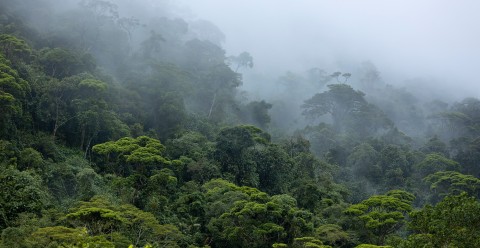
Tropical rainforests are hot, damp and humid throughout the year. The heavy rainfall and moisture can result in dense cloud coverage. © Maarten Zeehandelaar/ Shutterstock
What are tropical rainforests?
Rainforests are found on every continent except Antarctica, and they can be split into two broad categories – temperate and tropical.
Temperate rainforests grow in temperate climates – conditions that are neither extremely hot or extremely cold – which are typically found between the tropics and the polar regions. While they receive heavy rainfall, these forests have distinct seasons and experience cooler temperatures than tropical rainforests.
There are temperate rainforests in both the northern and southern hemispheres. For example, we find them in the UK, North America’s Pacific Northwest and Appalachian Mountains, parts of Norway, Japan, Australia and southwestern South America.

The Daintree rainforest is a UNESCO World Heritage site. © Barry Callister/ Shutterstock
Tropical rainforests are found in the tropical zone around the equator. This zone stretches around the globe between the Tropic of Cancer, which cuts across countries including Mexico, India and Algeria, and the Tropic of Capricorn, which crosses countries such as Paraguay, Namibia and Australia. However, not all places within the topical zone have a climate suitable for tropical rainforests.
Tropical rainforests have an equatorial climate. This means it’s hot and humid all year with abundant rainfall of at least 2,000 millimetres annually. In comparison, the UK received around 1,242 millimetres of rainfall in 2024.
Where are tropical rainforests?
The largest and probably best-known is the tropical Amazon rainforest. This vast area, which is centred around the Amazon River, covers over six million square kilometres and stretches across several countries, including Brazil, Peru and Bolivia. The Amazon rainforest is a biodiversity hotspot. It’s thought to be home to 10% of the world’s known plant and animal species – and new ones are being discovered regularly.
Tropical rainforests are also abundant across southeast Asia in countries such as Indonesia, Malaysia, Thailand and Vietnam. The Daintree rainforest in Australia is the oldest in the world – it’s thought to be around 180 million years old, making it much older than the Amazon rainforest.
What animals live in the tropical rainforest?

Orangutans spend most of their time in the trees. They live in the rainforests of Borneo and Sumatra. © SoapsPhotography/ Shutterstock

With their long claws, sloths can grip onto the branches of trees in the rainforest. © Al Carrera/ Shutterstock

Colugos have mottled fur. This helps them to blend into the bark of trees in the rainforests of southeast Asia. © Joshua Davenport/ Shutterstock

Exclusively found in the Congo basin, okapis are the only living relative of giraffes. They have a very long tongue that they use to get food from high up branches. © Jiri Hrebicek/ Shutterstock

Found in the forests of Central and South America, howler monkeys, as their name suggests, are capable of producing a loud call in order to assert their territory. © Martens Coyotes/ Shutterstock

Found in the rainforests of South America, bullet ants have one of the most painful insect stings in the world. © Vinicius R. Souza/ Shutterstock

Green anacondas are the heaviest snakes in the world and can be found in the Amazon River. Their eyes and nostrils are on the top of their heads as they spend most of their time in water. © FotoRequest/ Shutterstock

Jaguars call the Amazon rainforest home. They’re incredibly good swimmers and are normally found near the water. © Al Andrich/ Shutterstock

Pink river dolphins are freshwater cetaceans that live in the Amazon River. © Juerginho/ Shutterstock
Tropical rainforest ecosystems
Rainforests are made of clever structural layers, which all need each other to thrive.
The emergent layer
The emergent layer of the rainforest is the highest layer, made up of towering trees that rise above the dense canopy. These massive trees are exposed to full sunlight, strong winds and heavy rainfall. This makes this layer hot, dry and less sheltered than the forest below. The tall, umbrella-shaped crowns of the trees help capture sunlight from all directions.
The canopy layer
Sitting under the emergent layer, the rainforest canopy acts like a green roof, blocking around 95% of sunlight from reaching the lower layers.
The warm, humid conditions in the canopy layer support a vast range of animal life. Animals such as spider monkeys and sloths are specially adapted to life above ground in the trees and vines of the canopy.
Epiphytes are plants that live on the surface of trees in the canopy. Even though they’re supported by other plants, they’re not considered to be parasites as they don’t use them for food. Instead, they extract water from the air.
Lichens, mosses, ferns and orchids, which are examples of epiphytes, are well-adapted to life high above the forest floor. They play an important ecological role by increasing biodiversity, providing habitats for insects and small animals, and contributing to the water cycle of the whole rainforest.
“Epiphytes are water absorbing sponges and they are the heart of the forest because they accumulate lot of moisture, which is released over time. This is a major factor in the tropical forest,” explains Dr Gothamie Weerakoon, our Senior Curator of Lichens and Slime Moulds.

Epiphytes play a vital role in the process of recycling water in the rainforest. They grow on trees and extract nutrients from the air. © Mbarredo/ Shutterstock
The understory layer
The understory layer of the rainforest lies below the canopy. It’s a dark, humid environment.
A lot of plants in the understory layer produce brightly coloured flowers to attract pollinators, even in low light conditions. Many of them also have large leaves to catch the limited sunlight. Some common houseplants, such as zebra plants and ferns, are native to this layer.
The forest floor
At the base of the tropical rainforest is the forest floor. This dark, damp layer receives less than 2% of sunlight. This is also where a lot of matter is recycled, which is extremely important to the overall life cycle of the ecosystem.
The density of leaves and decaying animal and plant material in the tropical rainforest is high and most of it falls to the forest floor. Microorganisms ensure this matter is broken down and recycled.
“The microorganism world in a tropical rainforest is so high, so rich, so diverse, and these organisms are recycling and turning things back to nature,” says Gothamie.
“The plants are shedding leaves and animal density is very high, so everything needs to be recycled constantly. If the microorganisms don’t act fast, the matter can pile up to several metres in a year.”
Nature’s pharmacy
Tropical rainforests are a rich source of medicinal plants and compounds used in modern medicine. Around a quarter of the medicines we use today are derived from plants found in tropical rainforests.
Many important drugs have been developed from rainforest plants. For example, quinine, used to treat malaria, comes from the bark of Cinchona trees in South America. The rose periwinkle, native to Madagascar, produces compounds that are used to treat leukaemia and Hodgkin’s lymphoma. Other rainforest plants have been used in pain relief and to create treatments for heart disease, diabetes, asthma and infections. Some rainforest species also have anti-inflammatory and anti-viral agents.
However, this is only scratching the surface of what might be available in the tropics.

The rose periwinkle is one of many plants that have medicinal properties. © B R DIGITAL/ Shutterstock
“When I was a bachelor’s student, our botany professor always said every plant in a tropical rainforest is a herbal plant,” says Gothamie.
“When it comes to conservation, nothing should be disturbed because we still have not discovered the value of their medicinal and chemical side.”
“The medicinal value of the plant world in the tropics is underexplored. We human beings are depending on a very limited number of plants, mushrooms and other resources, but unfortunately, we have not yet discovered the true value of them,” explains Gothamie.
Rainforest deforestation
Rainforests are vital to the overall health of our planet. They are carbon sinks, which means they absorb greenhouse gasses. However, these incredible ecosystems are disappearing quickly.
Deforestation – the clearing of trees and forests, usually for human exploits – is a huge threat to rainforests. In 2024, the world saw a record-breaking loss of 67,000 square kilometres of primary rainforest – that’s an area about twice the size of Belgium. It equates to roughly 18 football pitches’ worth of forest being lost per minute.

Rainforests are rapidly being destroyed, which is having a devasting effect on the ecosystems and the things that live there. © PARALAXIS/ Shutterstock
One of the main drivers of rainforest deforestation is agriculture, especially the expansion of land for cattle ranching, soy production and palm oil plantations. In countries such as Brazil, large sections of the Amazon rainforest are burned or cleared to make way for these industries. In Indonesia and Malaysia, vast areas of rainforest have been cut down to make room for palm oil, which is used in many everyday products, including food, cosmetics and cleaning supplies.
Logging, both legal and illegal, also plays a major role. Valuable hardwood trees, such as mahogany, are cut down and exported, often with little regard for the environmental damage left behind. Additionally, building roads, dams and mines leads to further forest fragmentation and destruction
The consequences of deforestation are severe. “Most of the things in the rainforests will go extinct before we even see them, study them or collect them and that’s the tragic thing in the tropical belt and it’s happening rapidly,” says Gothamie.
“I think the tropical belt is most damaged because of all the human or anthropogenic activities. We are eradicating most of our resources to extinction before we even get to know about them.”
Efforts are being made to reduce deforestation through protected areas, reforestation projects and more sustainable farming and logging practices. However, the rate of forest loss remains high and urgent action is needed to protect these critical ecosystems before they disappear forever.
How can you help rainforests?
We can all do our bit to help protect the planet’s rainforests. For example, you could:
Support sustainable farming practices by buying food and drink with a Rainforest Alliance seal.
Reduce your consumption of products tied to rainforest deforestation, such as palm oil. Use the PalmOil Scan app as you shop to check how manufacturers source their palm oil. Or check for the RSPO logo to find products that use only certified sustainable palm oil.
Volunteer with the Woodland Trust or other charities working to protect the UK’s temperate rainforests.
Fixing Our Broken Planet
Discover science-backed, hopeful solutions that will help us to create a more sustainable world.
New gallery open now.


Don't miss a thing
Receive email updates about our news, science, exhibitions, events, products, services and fundraising activities. We may occasionally include third-party content from our corporate partners and other museums. We will not share your personal details with these third parties. You must be over the age of 13. Privacy notice.
Follow us on social media